
Three and done
The fitness industry has a vested interest in convincing you that more is always better. More sessions, more hours, more sacrifice. But if you're over 40, the "more is more" gospel isn't just impractical, it may actually be working against you.
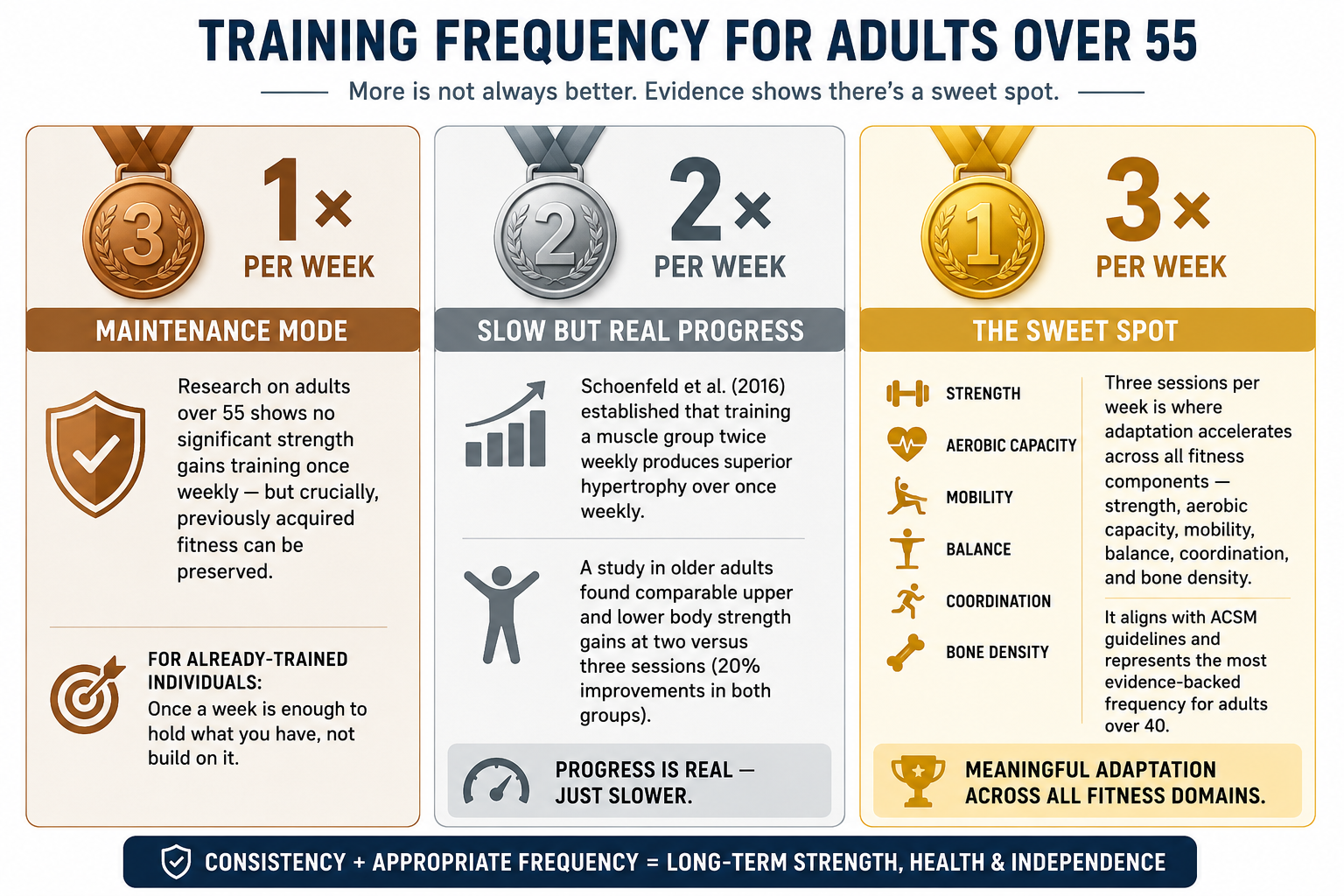
Three well structured sessions per week, of up to 60 minutes delivers the vast majority of fitness adaptations available to you. Here's what we know.
what the research actually shows
A 1989 study by Braith et al. found that two sessions per week produced 75% of the strength gains achieved by three, a meaningful gap. Ralston et al.'s 2018 meta-analysis confirmed that training 2–3 times per week holds the strongest evidence base for strength development across populations. The pattern is consistent: there is a dose response relationship between training frequency and adaptation, but it plateaus early.
the 4th and 5th sessions aren't worth it!
Going from three sessions to five doesn't double your results. The research suggests you might add a modest 10–15% more adaptation, but at a very different cost.
In your 20s, your body recovers from a hard session in 24–48 hours. By your 40s and 50s, that window extends to 48–72 hours or more. Testosterone and growth hormone, your primary anabolic drivers, decline roughly 1% per year after 40. Satellite cells, the muscle stem cells that drive repair become slower and less responsive. And a condition researchers call "inflammaging" means your post-exercise inflammatory response is both more intense and longer-lasting than it was two decades ago.
"From your 40s, recovery extends to 48–72 hours. Four or five sessions means training on tissue that hasn't fully repaired, your biology can begin to work against you."
Over weeks and months, that accumulation is precisely where overuse injuries and stalled progress are born. A sustainable three session structure wins every time.
Benefits of three Training sessions per week
Three sessions per week is where the science and the biology of the 40+ body align. With smart programming, every single session stimulates the systems that form your future health. Strength, cardiovascular fitness, mobility, balance, coordination, and bone density. Three hours a week. Every system covered.
Here's what that consistent stimulus delivers across each component:
Strength & muscle mass
Almost identical gains to 5 sessions, with a fraction of the wear and tear
Directly counteracts sarcopenia, the 3–8% muscle loss per decade that begins in your 40s
Sufficient volume to drive progressive overload session to session
Cardiovascular fitness
Reliable improvement of VO₂ max, one of the strongest predictors of longevity
Each unit increase in VO₂ max is associated with approximately 45 additional days of life
Adequate stimulus for meaningful mitochondrial and vascular adaptation
Mobility & flexibility
Three sessions provides the ideal stimulus to rest ratio for range of movement improvements
Reduced stiffness and postural decline that accelerates through the 40s and 50s
Balance & proprioception
Reduce fall risk by up to 21%
Builds reactive stability that protects joints, prevents injury, and keeps you moving confidently
Coordination & motor learning
Optimal neural adaptation, enough repetition to consolidate movement patterns, enough rest to avoid cognitive fatigue
Maintains high movement quality and body awareness that underpins everything else
Bone density
Three sessions of weight-bearing and resistance work maintains and improves bone mineral density
Particularly important for women post-menopause and men over 50, where bone loss accelerates
Recovery & hormonal health
Four recovery days allows full tissue repair, nervous system restoration, and hormonal reset
Each session lands on a fully recovered body, maximising the adaptive response every single time
Remember! If three sessions a week isn't always achievable, don't let that derail you. Two sessions will still move you forward. Progress will be a little slower, but it is real and it compounds. One session will allow you to maintain your fitness. The weeks to try and eliminate are the ones where you do nothing! .
The bottom line
Three sessions per week is the frequency at which the 40+ body adapts most efficiently. Where the stimulus is high enough to drive real change, and the recovery is sufficient to actually deliver it.
The extra sessions beyond three don't necessarily build a better body. They just build a more tired one.
You don't need to live in the gym to transform your health after 40. You need three well-programmed hours a week, applied consistently, and the patience to let the biology do its job. That's it. That's the whole game.
So what should those three sessions actually look like?
Knowing the frequency is one thing. Programming each session to cover all the bases, in the right order, at the right intensity, for where your body is right now is where it gets individual. The starting point looks different for everyone.
If you'd like to talk through what a smart three-session week could look like for you specifically, feel free to get in touch. No pressure, just a straightforward conversation about where you are and where you want to be.
KEY REFERENCES
Schoenfeld, B.J., Ogborn, D., & Krieger, J.W. (2016). Effects of resistance training frequency on measures of muscle hypertrophy. Sports Medicine, 46(11), 1689–1697.
Ralston, G.W., et al. (2018). Weekly training frequency effects on strength gain: a meta-analysis. Sports Medicine – Open, 4(1), 36.
Grgic, J., Schoenfeld, B.J., et al. (2018). Effect of resistance training frequency on gains in muscular strength. Sports Medicine, 48(5), 1207–1220.
Braith, R.W., et al. (1989). Comparison of 2 vs 3 days/week of variable resistance training. International Journal of Sports Medicine, 10(6), 450–454.
American College of Sports Medicine (ACSM) Position Stand on Exercise and Physical Activity for Older Adults.
